
We have turned attendance into a policing problem. Fines for families. Letters home in red ink. Attendance league tables pinned to staffroom walls, with tutor groups ranked like football clubs fighting relegation. Every new initiative rests on the same assumption, that young people stay away because they can get away with it, and that the cure is to make getting away with it harder.
That assumption is wrong. The headline numbers have edged the right way since the pandemic, yet the number of children missing half their schooling or more keeps climbing, around 176,000 of them in England last year. They are not skiving for a laugh. Many are anxious, overwhelmed, unseen, or convinced that school was built for someone else. We cannot fine our way out of that. A penalty notice does not make a child feel wanted. It just confirms what they already suspected.
Belonging Is the Precondition
Belonging is not a soft extra we get round to once behaviour is sorted. Humans learn in places where they feel safe, known and valued. Strip that away and even the brightest learner shuts down. Every teacher has seen it. The kid who coasts for one adult and grafts for another. The learner who turns up for one subject and nothing else, because that is the room where somebody knows their name.
The system is irrelevant here because it was designed to process bodies, not build relationships. Thirty in a room. Six different adults a day. A timetable that moves young people every hour like parcels through a sorting office. Then we act surprised when some of them feel like parcels.
It Doesn't Stop at Sixteen
Post-16 is where it bites hardest. Persistent absence peaks in the sixth form years, and FE colleges know the pattern well: learners who enrol in September full of intent and quietly fade by February because nobody noticed them slipping. Universities see it too. Only around six in ten undergraduates say they feel they belong at their institution, and first-in-family students score lower still. They don't leave because they can't do the work. They leave because nobody convinced them they were meant to be there.
Don't Smile Until Christmas
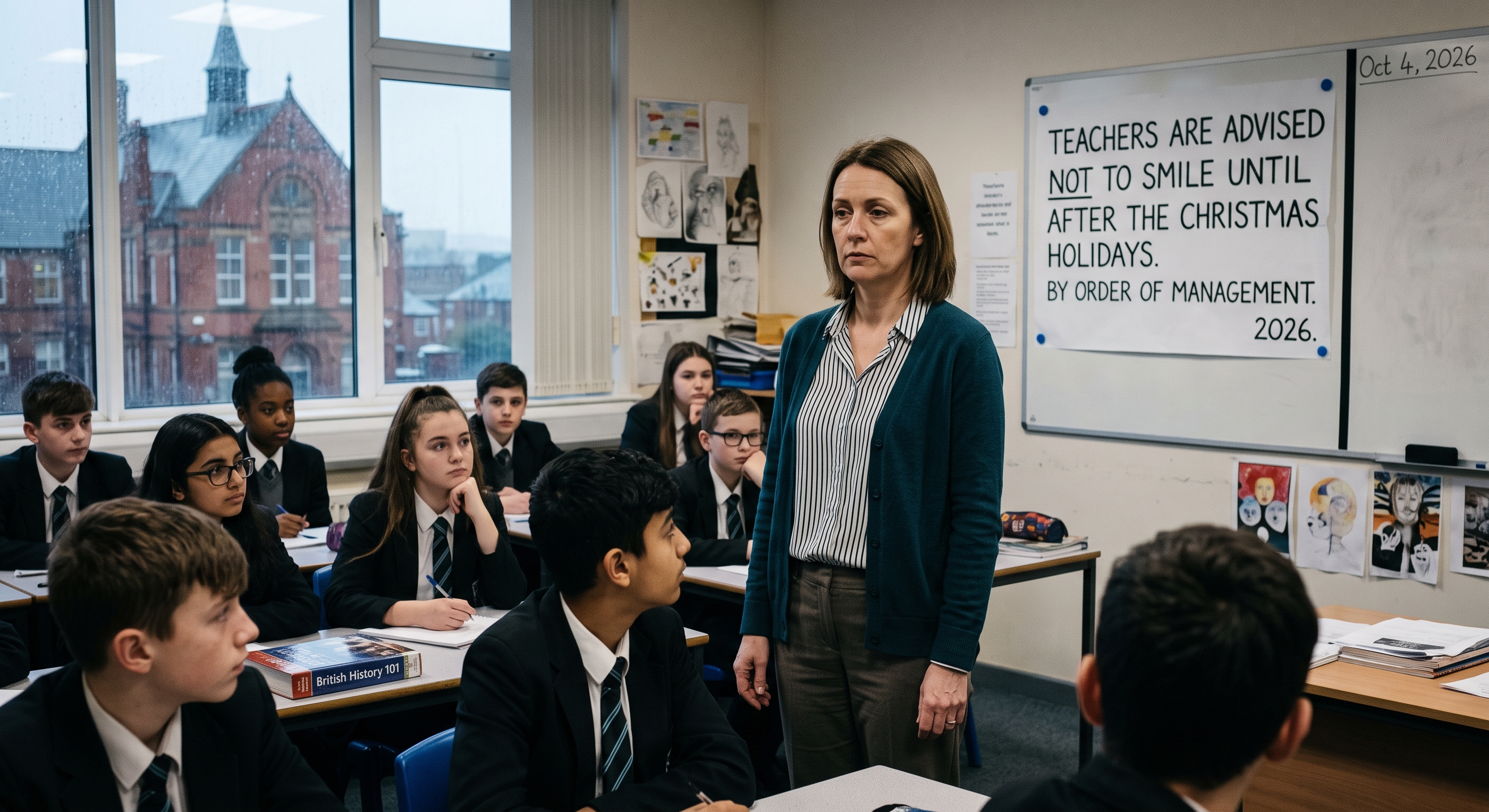
Most of us were handed the same piece of folklore in our first year in the classroom. Don't smile until Christmas. Set the tone, hold the line, show them you're not a pushover, and thaw out once the decorations go up. It was usually offered kindly, by someone who had survived a brutal first term and wanted to spare us the same. It's also one of the most damaging bits of advice the profession has ever passed down. The first weeks with a new group are exactly when belonging is built or lost. A learner who spends September and October facing an adult who has deliberately switched off their warmth doesn't learn respect. They learn that this room isn't for them. By Christmas, some of them have already stopped turning up to find out whether it gets any better.
Post-16 runs on the same clock. FE colleges know the first six weeks decide who's still on the register at Easter, and universities watch the same cliff edge open up in the first term. Cool, distant and "professional" is not a retention strategy.
None of this means abandoning high expectations or boundaries. Young people need both. But boundaries land differently when they come from someone who knows you. Warm and strict is not a contradiction. It's what great teachers have always done, often in spite of the system rather than because of it.
Half-Term Is the Reset Button
October half-term is drawing to a close, and that's good news. If the smile has stayed firmly in the drawer since September, nothing is lost that can't be won back. The second half-term is the perfect place to put it right. Greet them at the door by name. Ask one learner a question that has nothing to do with the lesson. Notice the haircut, the new trainers, the match they played at the weekend. Send a positive message home before a negative one ever needs to go. None of it costs a penny and none of it weakens a boundary. Nobody ever lost control of a room by being genuinely glad to see the people in it.
Key Takeaways
- Treat absence as a symptom. An empty seat is a message. Our job is to read it, not just record it.
- Design for connection on purpose. Every learner, at every stage, should be known well by at least one adult who notices when something shifts. A structural promise, not a pastoral bolt-on.
- Give tutors the time. Tutoring in schools, colleges and universities only works when it has real hours attached.
- Let learners see themselves. In the curriculum, on the walls, in the staff who teach them and in the decisions made about them. Belonging grows when people recognise themselves in what surrounds them.
- Measure belonging, not just bums on seats. We track attendance to two decimal places and belonging barely at all. That gap says everything about what we currently value.
The behaviour-first model asks young people to comply now and maybe belong later. It has it the wrong way round. Belonging comes first, and attendance, behaviour and achievement follow it through the door. The challenge for every school, college and university reading this is a simple one. For every learner on the absence list, name the adult who knows them well. If that box is empty, we've found the real problem. Then bin the folklore. Smile before Christmas, starting on the first morning back. Stop chasing the empty seats. Start building places worth turning up for.
Belonging Before Behaviour
We have turned attendance into a policing problem. Fines for families. Letters home in red ink. Attendance league tables pinned to staffroom walls, with tutor groups ranked like football clubs fighting relegation. Every new initiative rests on the same assumption, that young people stay away because they can get away with it, and that the cure is to make getting away with it harder.
That assumption is wrong. The headline numbers have edged the right way since the pandemic, yet the number of children missing half their schooling or more keeps climbing, around 176,000 of them in England last year. They are not skiving for a laugh. Many are anxious, overwhelmed, unseen, or convinced that school was built for someone else. We cannot fine our way out of that. A penalty notice does not make a child feel wanted. It just confirms what they already suspected.
Belonging Is the Precondition
Belonging is not a soft extra we get round to once behaviour is sorted. Humans learn in places where they feel safe, known and valued. Strip that away and even the brightest learner shuts down. Every teacher has seen it. The kid who coasts for one adult and grafts for another. The learner who turns up for one subject and nothing else, because that is the room where somebody knows their name.
The system is irrelevant here because it was designed to process bodies, not build relationships. Thirty in a room. Six different adults a day. A timetable that moves young people every hour like parcels through a sorting office. Then we act surprised when some of them feel like parcels.
It Doesn't Stop at Sixteen
Post-16 is where it bites hardest. Persistent absence peaks in the sixth form years, and FE colleges know the pattern well: learners who enrol in September full of intent and quietly fade by February because nobody noticed them slipping. Universities see it too. Only around six in ten undergraduates say they feel they belong at their institution, and first-in-family students score lower still. They don't leave because they can't do the work. They leave because nobody convinced them they were meant to be there.
Don't Smile Until Christmas
Most of us were handed the same piece of folklore in our first year in the classroom. Don't smile until Christmas. Set the tone, hold the line, show them you're not a pushover, and thaw out once the decorations go up. It was usually offered kindly, by someone who had survived a brutal first term and wanted to spare us the same. It's also one of the most damaging bits of advice the profession has ever passed down. The first weeks with a new group are exactly when belonging is built or lost. A learner who spends September and October facing an adult who has deliberately switched off their warmth doesn't learn respect. They learn that this room isn't for them. By Christmas, some of them have already stopped turning up to find out whether it gets any better.
Post-16 runs on the same clock. FE colleges know the first six weeks decide who's still on the register at Easter, and universities watch the same cliff edge open up in the first term. Cool, distant and "professional" is not a retention strategy.
None of this means abandoning high expectations or boundaries. Young people need both. But boundaries land differently when they come from someone who knows you. Warm and strict is not a contradiction. It's what great teachers have always done, often in spite of the system rather than because of it.
Half-Term Is the Reset Button
October half-term is drawing to a close, and that's good news. If the smile has stayed firmly in the drawer since September, nothing is lost that can't be won back. The second half-term is the perfect place to put it right. Greet them at the door by name. Ask one learner a question that has nothing to do with the lesson. Notice the haircut, the new trainers, the match they played at the weekend. Send a positive message home before a negative one ever needs to go. None of it costs a penny and none of it weakens a boundary. Nobody ever lost control of a room by being genuinely glad to see the people in it.
Key Takeaways
- Treat absence as a symptom. An empty seat is a message. Our job is to read it, not just record it.
- Design for connection on purpose. Every learner, at every stage, should be known well by at least one adult who notices when something shifts. A structural promise, not a pastoral bolt-on.
- Give tutors the time. Tutoring in schools, colleges and universities only works when it has real hours attached.
- Let learners see themselves. In the curriculum, on the walls, in the staff who teach them and in the decisions made about them. Belonging grows when people recognise themselves in what surrounds them.
- Measure belonging, not just bums on seats. We track attendance to two decimal places and belonging barely at all. That gap says everything about what we currently value.
The behaviour-first model asks young people to comply now and maybe belong later. It has it the wrong way round. Belonging comes first, and attendance, behaviour and achievement follow it through the door. The challenge for every school, college and university reading this is a simple one. For every learner on the absence list, name the adult who knows them well. If that box is empty, we've found the real problem. Then bin the folklore. Smile before Christmas, starting on the first morning back. Stop chasing the empty seats. Start building places worth turning up for.