
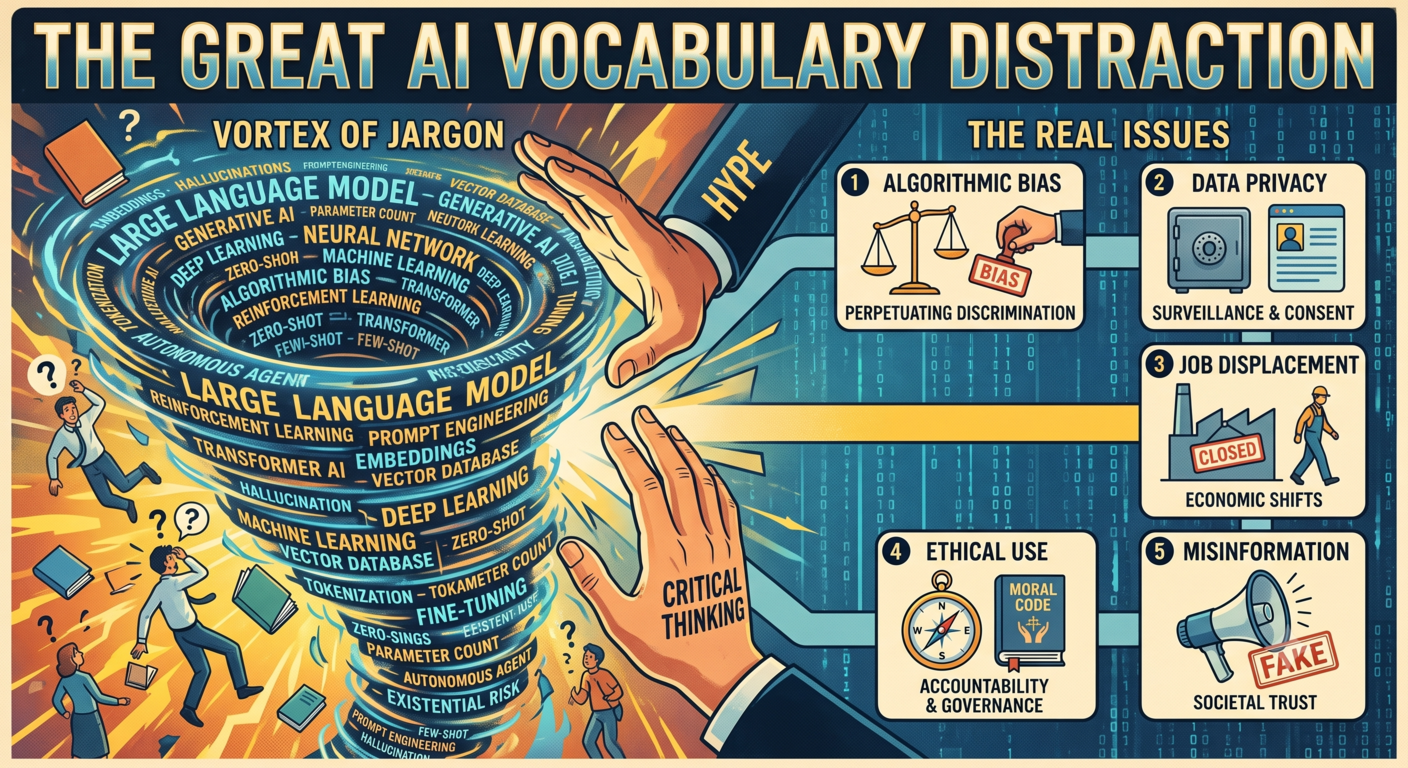
Three camps have formed in education over what to call the thing we're trying to teach children about artificial intelligence. One insists on AI literacy, because that's the language we already use for reading, media and financial capability. Another pushes for AI fluency, arguing that literacy implies a floor when what we actually need is comfort and range. A third wants AI competency, because competency frameworks are what get signed off by governing bodies and funding panels.
Meanwhile the technology has moved twice since this paragraph started.
That's the irony sitting at the heart of this whole debate. We're locked in a seminar room arguing about the correct label for a skill nobody has agreed how to teach, while the thing itself keeps changing shape underneath us. It would be funny if it weren't such a perfect case study in what's wrong with the system.
The word war is the symptom, not the story
Education loves a taxonomy. Give us a new challenge and our first instinct isn't to go and try something, it's to convene a working group and produce a definitions document. We did it with digital literacy. We did it with twenty-first century skills. Now we're doing it again with AI, and the pattern tells you everything about why the system struggles to keep pace with the world it's meant to be preparing children for.
The argument over literacy versus fluency versus competency isn't really about semantics. It's about control. Whoever wins the label gets to write the framework, own the curriculum slot, and decide what counts as evidence of learning. That's a governance fight wearing a linguistics costume, and children are waiting on the other side of it for someone to just start teaching them something useful.
What the framework debate is quietly avoiding
None of the three camps has answered the question that actually matters: what do we want a sixteen year old to be able to do with AI that they can't do now, and why? Not what we want to call their skill level. What we want them to actually do.
In Pick 'n' Mix Education we wrote about agency with guardrails, the idea that young people don't need to be shielded from a tool or fully unleashed on it, they need structured room to use it, question it, and learn where it fails. That's not a literacy outcome or a fluency outcome or a competency outcome. It's a design principle. It tells you how to build the learning experience regardless of which word ends up on the certificate.
The obsession with naming the skill is a stalling tactic, whether anyone intends it that way or not. It lets institutions look like they're taking AI seriously, producing documents and running training days, without ever having to answer the harder question of what actually changes in a classroom on a Tuesday morning.
Stop defining it, start doing it
Children don't experience their AI use as literacy or fluency or competency. They experience it as trying something, watching it half work, adjusting, and trying again. That's not a new category of skill. It's the same iterative, messy, human process good teachers have always tried to build, just applied to a new tool.
The schools getting this right aren't the ones with the tightest definition on their curriculum map. They're the ones that gave staff permission to experiment before the policy was finished, that treated the technology as something to interrogate rather than certify, and that trusted teachers to work out what mattered in their own subject rather than waiting for a national framework to tell them.
That's the actual work. Everything else is furniture.
Five Takeaways
- The label doesn't teach the skill. Whether you call it literacy, fluency or competency, none of it means anything until it shows up in what students can actually do.
- The argument over terminology is a governance fight. Naming rights decide who owns the curriculum and the funding, which is exactly why the debate won't resolve quickly.
- Agency with guardrails beats any framework. Structured room to try, fail and adjust teaches more than a competency statement ever will.
- Waiting for consensus is its own decision. Every term spent arguing about definitions is a term children spend without proper support.
- Teachers, not taxonomies, will solve this. The people closest to students are better placed to work out what matters than any committee producing a glossary.
We don't need to win the argument over what to call this skill. We need to stop treating the argument as the work. The system that keeps reaching for a new label instead of a new approach isn't struggling because it lacks the right word. It's struggling because it was built for a world where you could define a skill once and teach it the same way for a decade, and that world is gone. Call it what you like. Just teach it like it matters, because the strength of the wolf is the pack, and the pack doesn't have time to wait for a definitions document.
The Great AI Vocabulary Distraction
Three camps have formed in education over what to call the thing we're trying to teach children about artificial intelligence. One insists on AI literacy, because that's the language we already use for reading, media and financial capability. Another pushes for AI fluency, arguing that literacy implies a floor when what we actually need is comfort and range. A third wants AI competency, because competency frameworks are what get signed off by governing bodies and funding panels.
Meanwhile the technology has moved twice since this paragraph started.
That's the irony sitting at the heart of this whole debate. We're locked in a seminar room arguing about the correct label for a skill nobody has agreed how to teach, while the thing itself keeps changing shape underneath us. It would be funny if it weren't such a perfect case study in what's wrong with the system.
The word war is the symptom, not the story
Education loves a taxonomy. Give us a new challenge and our first instinct isn't to go and try something, it's to convene a working group and produce a definitions document. We did it with digital literacy. We did it with twenty-first century skills. Now we're doing it again with AI, and the pattern tells you everything about why the system struggles to keep pace with the world it's meant to be preparing children for.
The argument over literacy versus fluency versus competency isn't really about semantics. It's about control. Whoever wins the label gets to write the framework, own the curriculum slot, and decide what counts as evidence of learning. That's a governance fight wearing a linguistics costume, and children are waiting on the other side of it for someone to just start teaching them something useful.
What the framework debate is quietly avoiding
None of the three camps has answered the question that actually matters: what do we want a sixteen year old to be able to do with AI that they can't do now, and why? Not what we want to call their skill level. What we want them to actually do.
In Pick 'n' Mix Education we wrote about agency with guardrails, the idea that young people don't need to be shielded from a tool or fully unleashed on it, they need structured room to use it, question it, and learn where it fails. That's not a literacy outcome or a fluency outcome or a competency outcome. It's a design principle. It tells you how to build the learning experience regardless of which word ends up on the certificate.
The obsession with naming the skill is a stalling tactic, whether anyone intends it that way or not. It lets institutions look like they're taking AI seriously, producing documents and running training days, without ever having to answer the harder question of what actually changes in a classroom on a Tuesday morning.
Stop defining it, start doing it
Children don't experience their AI use as literacy or fluency or competency. They experience it as trying something, watching it half work, adjusting, and trying again. That's not a new category of skill. It's the same iterative, messy, human process good teachers have always tried to build, just applied to a new tool.
The schools getting this right aren't the ones with the tightest definition on their curriculum map. They're the ones that gave staff permission to experiment before the policy was finished, that treated the technology as something to interrogate rather than certify, and that trusted teachers to work out what mattered in their own subject rather than waiting for a national framework to tell them.
That's the actual work. Everything else is furniture.
Five Takeaways
- The label doesn't teach the skill. Whether you call it literacy, fluency or competency, none of it means anything until it shows up in what students can actually do.
- The argument over terminology is a governance fight. Naming rights decide who owns the curriculum and the funding, which is exactly why the debate won't resolve quickly.
- Agency with guardrails beats any framework. Structured room to try, fail and adjust teaches more than a competency statement ever will.
- Waiting for consensus is its own decision. Every term spent arguing about definitions is a term children spend without proper support.
- Teachers, not taxonomies, will solve this. The people closest to students are better placed to work out what matters than any committee producing a glossary.
We don't need to win the argument over what to call this skill. We need to stop treating the argument as the work. The system that keeps reaching for a new label instead of a new approach isn't struggling because it lacks the right word. It's struggling because it was built for a world where you could define a skill once and teach it the same way for a decade, and that world is gone. Call it what you like. Just teach it like it matters, because the strength of the wolf is the pack, and the pack doesn't have time to wait for a definitions document.