

A grade is a photograph. It captures one moment, in one set of conditions, on one particular morning when a teenager either slept well or didn't, ate breakfast or didn't, drew the question they'd revised or the one they'd skipped. We then take that photograph, frame it, and treat it as the definitive likeness of a human being for the rest of their life.
The trouble with photographs is that people keep growing after the shutter clicks. The trouble with grades is that we pretend they don't.
We have built an entire system around a handful of imaginary endpoints. GCSEs, A-Levels, the degree. Each one sold as arrival, as the line you cross to become finished. And every time a young person crosses one, we hand them a number and quietly suggest that the number is now who they are. Settled. Filed. Done.
It is one of the most damaging fictions in education, and it is time we stopped telling it.
Knowledge Has a Shelf Life
Here is the uncomfortable arithmetic. The World Economic Forum's Future of Jobs Report 2025 found that employers expect 39% of workers' core skills to change by 2030. That figure was 44% in 2023. Think about what that means for a child sitting their GCSEs this summer. By the time they finish a degree, a meaningful chunk of what counted as essential when they started will have quietly expired.
The same report puts it in starker terms. If the world's workforce were a room of 100 people, 59 of them would need retraining by 2030. Not the unlucky ones. Not the ones who fell behind. The majority.
So what exactly are we certifying when we stamp a grade on a sixteen-year-old? A snapshot of what they knew, on the day we asked, about content with a half-life. We are measuring a moment and selling it as a verdict.
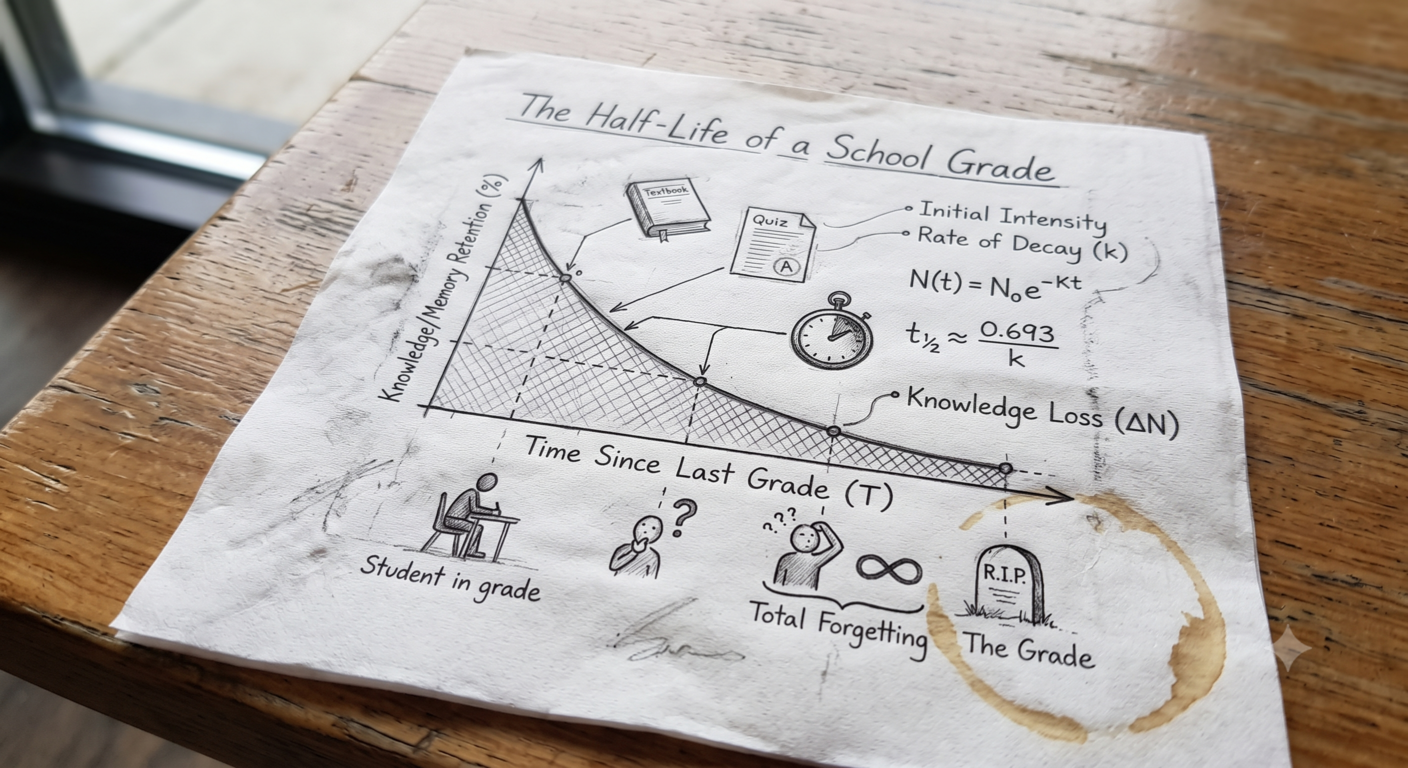
A grade is not wrong, as such. It is just radioactive. It starts decaying the instant it is awarded, and we keep behaving as though it lasts forever because permanence is convenient. It fits in a UCAS form. It slots into a league table. It lets an admissions officer sort a thousand humans into a tidy queue without ever meeting one of them. The grade serves the system's need for a full stop. It does not serve the learner.
The People Who Peak at the Finish Line
Picture the student who has done everything right. Thirteen years of crossing lines. Every certificate collected, every box ticked, every endpoint reached on schedule. We have trained them, brilliantly, to perform for an audience and to treat each qualification as a destination.
Then they arrive in the actual world and the audience vanishes. Nobody hands them a syllabus. Nobody tells them what will be on the exam, because there is no exam, because the thing they need to know hasn't been invented yet. The career will not be linear. The job they take at twenty-two may not exist at thirty-five. The single most useful thing they could possibly own is the one thing the finish-line model never taught them to value: the assumption that they are never finished.
That is the real danger of treating a degree as an end. Not that the qualification is worthless, but that the full stop we attach to it is a lie. We send young people out believing the running is over precisely at the moment the real race begins.
Learning Was Never a Race
The fix is not to abolish exams or pretend qualifications don't matter. They open doors, and pretending otherwise helps nobody. The fix is to stop mistaking the milestone for the journey.
The WEF's own list of the fastest-rising skills for the rest of this decade is telling. Alongside the technical stuff sits curiosity and lifelong learning, climbing fast. The market has worked out what our assessment system still refuses to admit. The valuable thing is not the grade you banked at eighteen. It is whether you are still learning at thirty-eight, at fifty-eight, at any point after the certificates stopped coming.
So we treat each qualification as a comma, not a full stop. We tell students the truth, that a grade is a snapshot and snapshots fade. We build the habits of continuous learning into the system rather than bolting "lifelong learning" on as a slogan once the schooling is over. And we measure growth, not just arrival, so that the kid who travels furthest gets seen even when they didn't start at the front.
Five Things Worth Holding Onto
- A grade is a snapshot, not a verdict. It captures one morning's performance on content that will not stay current. Treat it as a moment in a story, never the final page.
- Knowledge decays, so design for it. With around two-fifths of core skills set to shift by 2030, the only future-proof outcome is a learner who keeps learning. Build that in from the start.
- The full stop is the danger, not the qualification. Exams open doors and that matters. The harm is in telling a young person the running is over the moment they cross a line.
- Lifelong learning is a skill, not a slogan. Curiosity and the ability to keep retraining are now among the most valuable things a person can carry. Stop treating them as an afterthought to the "real" education.
- Measure the journey, not just the milestone. Growth over time tells you more about a learner than a single number ever could. Build assessment that can see the distance travelled.
We have spent generations teaching children to sprint towards lines that dissolve the moment they cross them, then acting surprised when they reach the far side with no idea where to run next. The finish line was always a fiction. Learning does not stop at sixteen, or eighteen, or twenty-one, and a system built on the pretence that it does is preparing young people for a world that no longer exists. The most powerful thing we can give a learner is not a grade that decays in the drawer, but the unshakeable belief that they are never, ever done. That is not a softer education. It is a tougher, truer one, and the children inheriting this century deserve nothing less. The strength of the pack is the wolf, and the strength of the wolf is the pack. None of us crosses a finish line, because there isn't one. There is only the next thing worth learning, and the people we learn it alongside.
The Half-Life of a Grade
A grade is a photograph. It captures one moment, in one set of conditions, on one particular morning when a teenager either slept well or didn't, ate breakfast or didn't, drew the question they'd revised or the one they'd skipped. We then take that photograph, frame it, and treat it as the definitive likeness of a human being for the rest of their life.
The trouble with photographs is that people keep growing after the shutter clicks. The trouble with grades is that we pretend they don't.
We have built an entire system around a handful of imaginary endpoints. GCSEs, A-Levels, the degree. Each one sold as arrival, as the line you cross to become finished. And every time a young person crosses one, we hand them a number and quietly suggest that the number is now who they are. Settled. Filed. Done.
It is one of the most damaging fictions in education, and it is time we stopped telling it.
Knowledge Has a Shelf Life
Here is the uncomfortable arithmetic. The World Economic Forum's Future of Jobs Report 2025 found that employers expect 39% of workers' core skills to change by 2030. That figure was 44% in 2023. Think about what that means for a child sitting their GCSEs this summer. By the time they finish a degree, a meaningful chunk of what counted as essential when they started will have quietly expired.
The same report puts it in starker terms. If the world's workforce were a room of 100 people, 59 of them would need retraining by 2030. Not the unlucky ones. Not the ones who fell behind. The majority.
So what exactly are we certifying when we stamp a grade on a sixteen-year-old? A snapshot of what they knew, on the day we asked, about content with a half-life. We are measuring a moment and selling it as a verdict.
A grade is not wrong, as such. It is just radioactive. It starts decaying the instant it is awarded, and we keep behaving as though it lasts forever because permanence is convenient. It fits in a UCAS form. It slots into a league table. It lets an admissions officer sort a thousand humans into a tidy queue without ever meeting one of them. The grade serves the system's need for a full stop. It does not serve the learner.
The People Who Peak at the Finish Line
Picture the student who has done everything right. Thirteen years of crossing lines. Every certificate collected, every box ticked, every endpoint reached on schedule. We have trained them, brilliantly, to perform for an audience and to treat each qualification as a destination.
Then they arrive in the actual world and the audience vanishes. Nobody hands them a syllabus. Nobody tells them what will be on the exam, because there is no exam, because the thing they need to know hasn't been invented yet. The career will not be linear. The job they take at twenty-two may not exist at thirty-five. The single most useful thing they could possibly own is the one thing the finish-line model never taught them to value: the assumption that they are never finished.
That is the real danger of treating a degree as an end. Not that the qualification is worthless, but that the full stop we attach to it is a lie. We send young people out believing the running is over precisely at the moment the real race begins.
Learning Was Never a Race
The fix is not to abolish exams or pretend qualifications don't matter. They open doors, and pretending otherwise helps nobody. The fix is to stop mistaking the milestone for the journey.
The WEF's own list of the fastest-rising skills for the rest of this decade is telling. Alongside the technical stuff sits curiosity and lifelong learning, climbing fast. The market has worked out what our assessment system still refuses to admit. The valuable thing is not the grade you banked at eighteen. It is whether you are still learning at thirty-eight, at fifty-eight, at any point after the certificates stopped coming.
So we treat each qualification as a comma, not a full stop. We tell students the truth, that a grade is a snapshot and snapshots fade. We build the habits of continuous learning into the system rather than bolting "lifelong learning" on as a slogan once the schooling is over. And we measure growth, not just arrival, so that the kid who travels furthest gets seen even when they didn't start at the front.
Five Things Worth Holding Onto
- A grade is a snapshot, not a verdict. It captures one morning's performance on content that will not stay current. Treat it as a moment in a story, never the final page.
- Knowledge decays, so design for it. With around two-fifths of core skills set to shift by 2030, the only future-proof outcome is a learner who keeps learning. Build that in from the start.
- The full stop is the danger, not the qualification. Exams open doors and that matters. The harm is in telling a young person the running is over the moment they cross a line.
- Lifelong learning is a skill, not a slogan. Curiosity and the ability to keep retraining are now among the most valuable things a person can carry. Stop treating them as an afterthought to the "real" education.
- Measure the journey, not just the milestone. Growth over time tells you more about a learner than a single number ever could. Build assessment that can see the distance travelled.
We have spent generations teaching children to sprint towards lines that dissolve the moment they cross them, then acting surprised when they reach the far side with no idea where to run next. The finish line was always a fiction. Learning does not stop at sixteen, or eighteen, or twenty-one, and a system built on the pretence that it does is preparing young people for a world that no longer exists. The most powerful thing we can give a learner is not a grade that decays in the drawer, but the unshakeable belief that they are never, ever done. That is not a softer education. It is a tougher, truer one, and the children inheriting this century deserve nothing less. The strength of the pack is the wolf, and the strength of the wolf is the pack. None of us crosses a finish line, because there isn't one. There is only the next thing worth learning, and the people we learn it alongside.